记忆方法
将“fleet”分解为“f”和“leet”,想象一个“leet”团队(通常指技术高超的玩家),这个团队非常快速、灵活,就像一群鸟(fleet的另一种含义)一样迅速飞行。通过这种图像记忆法,可以帮助记住单词“fleet”的快速、流动的含义。
机器生成的内容难免有错,看到不靠谱的拆解请告诉我们
词族 · fleet
中文词源
fleet 舰队
来自PIE*pleu,浮动,流,词源同flow, float, pluvial. 用来指船只,舰队。
英语词源
- fleet
-
fleet: [OE] Fleet is one of a vast tangled web of words which traces its history back ultimately to Indo-European *pleu-, denoting ‘flow, float’ (amongst its other English descendants are fly, flood, flow, fledge, fowl, plover, and pluvial). Fleet itself comes from the extended Indo- European base *pleud-, via the Germanic verb *fleutan and Old English flēotan ‘float, swim’ (modern English float comes from the related Old English flotian).
The verb has now virtually died out, but it survives in the form of the present participial adjective fleeting, which developed the sense ‘transient’ in the 16th century, and in the derived noun fleet: Old English seems to have had two distinct nouns flēot based on the verb flēotan, one of which meant ‘ships’, and the other of which signified ‘creek, inlet’ (it survives in the name of London’s Fleet Street, which runs down to the now covered-up Thames tributary, the river Fleet).
The adjective fleet ‘quick’ (as in ‘fleet of foot’) was probably borrowed from Old Norse fljótr, likewise a descendant of Germanic *fleut-.
=> fledge, float, flood, flow, fowl, plover, pluvial - fleet (n.)
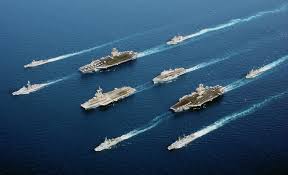
- Old English fleot "a ship, raft, floating vessel," also, collectively, "means of sea travel; boats generally," from fleotan "to float" (see fleet (v.)). Sense of "naval force, group of ships under one command" is in late Old English. The more usual Old English word was flota "a ship," also "a fleet; a sailor." The fleet for "the navy" is from 1712.
The Old English word also meant "estuary, inlet, flow of water," especially the one into the Thames near Ludgate Hill, which lent its name to Fleet Street (home of newspaper and magazine houses, standing for "the English press" since 1882), Fleet prison (long used for debtors), etc. - fleet (adj.)
- "swift," 1520s, but probably older than the record; apparently from or cognate with Old Norse fliotr "swift," from Proto-Germanic *fleuta, which is related to the source of fleet (v.). Related: Fleetness.
- fleet (v.)
- Old English fleotan "to float; drift; flow, run (as water); swim; sail (of a ship)," from Proto-Germanic *fleutan (cognates: Old Frisian fliata, Old Saxon fliotan "to flow," Old High German fliozzan "to float, flow," German fliessen "to flow, run, trickle" (as water), Old Norse fliota "to float, flow"), from PIE root *pleu- "to flow, swim" (see pluvial).
Meaning "to glide away like a stream, vanish imperceptibly" is from c. 1200; hence "to fade, to vanish" (1570s). Related: Fleeted; fleeting.
权威例句
- 1. A fleet of ambulances took the injured to hospital.
- 一队救护车把伤者送往医院。
- 2. He ordered the combined fleet to convoy troops to Naples.
- 他命令联合舰队将军队护送到那不勒斯。
- 3. Using an alias, he had rented a house in Fleet, Hampshire.
- 他用化名在汉普郡的舰队街租了间房子。
- 4. In contrast with its surface fleet, Britain's submarine force was relatively small.
- 同其水面舰队相比,英国的潜艇部队规模相对较小。
- 5. A fleet of police cars suddenly arrived. Dozens of officers piled out.
- 突然开来一队警车,数十个警察一拥而出。
词语辨析
【fleet, navy】
这组词都有“船队,舰队”的意思,其区别是:
fleet: 指一个国家包括商船在内所有船只的总数,也可指某一地区由军方或民间拥有船只的总数。
navy: 指国家战舰和全部海上武力部队,包括士兵、补给站和装备在内。
这组词都有“船队,舰队”的意思,其区别是:
fleet: 指一个国家包括商船在内所有船只的总数,也可指某一地区由军方或民间拥有船只的总数。
navy: 指国家战舰和全部海上武力部队,包括士兵、补给站和装备在内。