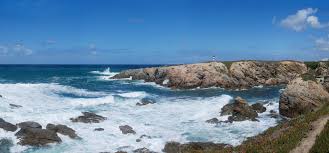
记忆方法
1. 在大海(ocean)的边上,则是大海的oc,转换成了co,所以与海有关是海岸线。
看到不对的地方请告诉我们
词族 · coast
中文词源
coast 海岸
来自拉丁语costa,肋骨,边,词源同costal,accost.词义由岸边引申为海岸。
英语词源
- coast
-
coast: [13] Latin costa meant ‘rib’ (hence the English medical term intercostal ‘between the ribs’), but also more generally ‘flank, side’. It was in this sense that it passed into Old French as coste, and subsequently into English. The modern meaning ‘seashore’ (which had already developed in Old French) arises from the shore being thought of as the ‘side’ or ‘edge’ of the land (compare seaside).
Amongst the senses of the French word little represented in English is ‘hillside, slope’; it was however adopted in North America for a ‘slope down which one slides on a sledge’, and came to be used in the mid 19th century as a verb meaning ‘sledge down such a slope’. That was the source of the modern verbal sense ‘freewheel’. The coster of costermonger [16] was originally costard, a variety of apple named from its prominent ‘ribs’.
And another hidden relative is cutlet [18], borrowed from French côtelette, literally ‘little rib’.
=> costermonger, cutlet, intercostal - coast (n.)
- "margin of the land," early 14c.; earlier "rib as a part of the body" (early 12c.), from Old French coste "rib, side, flank; slope, incline;" later "coast, shore" (12c., Modern French côte), from Latin costa "a rib," perhaps related to a root word for "bone" (compare Old Church Slavonic kosti "bone," also see osseous).
Latin costa developed a secondary sense in Medieval Latin of "the shore," via notion of the "side" of the land, as well as "side of a hill," and this passed into Romanic (Italian costa "coast, side," Spanish cuesta "slope," costa "coast"), but only in the Germanic languages that borrowed it is it fully specialized in this sense (Dutch kust, Swedish kust, German Küste, Danish kyst). French also used this word for "hillside, slope," which led to verb meaning "sled downhill," first attested 1775 in American English. Expression the coast is clear (16c.) is an image of landing on a shore unguarded by enemies. - coast (v.)
- late 14c., "to skirt, to go around the sides, to go along the border" of something (as a ship does the coastline), from Anglo-French costien, from the French source of coast (n.). The meaning "sled downhill," first attested 1775 in American English, is a separate borrowing. Of motor vehicles, "to move without thrust from the engine," by 1925; figurative use, of persons, "not to exert oneself," by 1934. Related: Coasted; coasting.
权威例句
- 1. The boat was anchored off the northern coast of the peninsula.
- 这艘船停泊在离该半岛北部海岸不远的地方。
- 2. The Atlantic coast is within sight of the hotel.
- 从宾馆可以看见大西洋海岸。
- 3. He recognized the coast of England through a veil of mist.
- 透过薄雾他认出了那是英格兰的海岸线。
- 4. The town was Redcar, a seaside resort on the Cleveland coast.
- 那个城镇叫雷德卡,是克利夫兰海岸上的一个海滨胜地。
- 5. He was drowned in a shipwreck off the coast of Spain.
- 他在西班牙海岸附近的一次海难中溺水身亡。
词语辨析
【shore, bank, seaside, beach, coast】
这组词都有“岸”的意思,其区别是:
shore: 指紧靠大湖泊或海洋的陆地边缘或靠海的休养地。
bank: 多指有一定坡度的河岸、湖岸或堤岸。
seaside: 尤指疗养地、游览地区的海边。
beach: 指倾斜度小,被海、湖或河水冲刷而有沙或卵石积存的地方。
coast: 地理学上的名词,专指被视为边界的沿海陆地的尽头。
这组词都有“岸”的意思,其区别是:
shore: 指紧靠大湖泊或海洋的陆地边缘或靠海的休养地。
bank: 多指有一定坡度的河岸、湖岸或堤岸。
seaside: 尤指疗养地、游览地区的海边。
beach: 指倾斜度小,被海、湖或河水冲刷而有沙或卵石积存的地方。
coast: 地理学上的名词,专指被视为边界的沿海陆地的尽头。