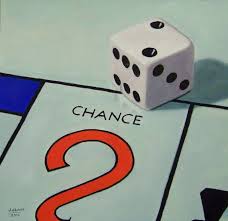
记忆方法
chance.........巧 死(了,真巧)........偶然;碰巧
看到不对的地方请告诉我们
词族 · chance
中文词源
chance 机会
来自拉丁词cadens, 掉落,词源同case, accident. 即偶发事件。
英语词源
- chance
-
chance: [13] Like the related case, chance originally meant ‘that which befalls (by accident, also a relative)’. It comes ultimately from Vulgar Latin *cadēre, a descendant of Latin cadere ‘fall’ (source of English cadence and cadenza). This passed into Old French as cheoir, whose noun derivatives included cheoite (source of English chute) and cheance, acquired by English via Anglo-Norman chaunce.
=> accident, cadence, case, chute - chance (v.)
- late 14c., "to come about, to happen," from chance (n.). Meaning "to risk" attested from 1859. Related: Chanced; chancing.
- chance (n.)
- c. 1300, "something that takes place, what happens, an occurrence" (good or bad, but more often bad), from Old French cheance "accident, chance, fortune, luck, situation, the falling of dice" (12c., Modern French chance), from Vulgar Latin *cadentia "that which falls out," a term used in dice, from neuter plural of Latin cadens, present participle of cadere "to fall" (see case (n.1)).
In English frequently in plural, chances. The word's notions of "opportunity" and "randomness" are as old as the record of it in English and now all but crowd out the word's original notion of "mere occurrence." Main chance "thing of most importance" is from 1570s, bearing the older sense. The mathematical (and hence odds-making) sense is attested from 1778. To stand a chance (or not) is from 1796.
To take (one's) chances "accept what happens" (early 14c.) is from the old, neutral sense; to take a chance/take chances is originally (by 1814) "participate in a raffle or lottery or game;" extended sense of "take a risk" is by 1826.
权威例句
- 1. They had met by chance at university and finished up getting married.
- 他们在大学偶遇,最后结了婚。
- 2. If cancers are spotted early there'sa high chance of survival.
- 如果癌症在早期发现的话,存活的几率会很高。
- 3. He did not get a chance to deepen his knowledge of Poland.
- 他没有机会更深入地了解波兰。
- 4. He has almost certainly blown his chance of touring India this winter.
- 他几乎肯定失去了今冬去印度旅行的机会。
- 5. There is a chance of sunny spells in the West.
- 西部可能会有一段天气晴朗的日子。
词语辨析
【take place, chance, happen, occur】
这组词都有“发生”的意思,其区别是:
take place: 多指通过人为安排的发生。
chance: 侧重事前无安排或无准备而发生的事,特指巧合。
happen: 普通用词,泛指一切客观事物或情况的发生,强调动作的偶然性。
occur: 较正式用词,可指意外地发生,也可指意料中的发生。
【risk, hazard, venture, chance, dare】
这组词都有“敢于冒险”的意思,其区别是:
risk: 指不顾个人安危去干某事,侧重主动承担风险。
hazard: 主要指冒险作出某个选择,隐含碰运气意味。
venture: 指冒风险试一试,或指有礼貌的反抗或反对。
chance: 指碰运气、冒风险试试。
dare: 可与venture换用,但语气较强,着重挑战或违抗。
【opportunity, occasion, chance】
opportunity: 主要指能够去做某事,尤其是达到自己目的,实现某种愿望的好机会。如:You should make the most of your opportunities of seeing the country and learning the language.(你应该尽量利用你的机会去看看这个国家,学习它的语言。)
occasion: 主要指“时机”,“场合”,也含有“机会”的意思。如:The flags are hung out on the occasion of the National Day.(每逢国庆节,国旗都悬持出来了。)
chance: 多指偶然的机会,意外的机会,带有侥幸的意味。如:Even so, it was a lucky chance that he could do it.(即使如此,那也是他凭着侥幸才做到这点。)